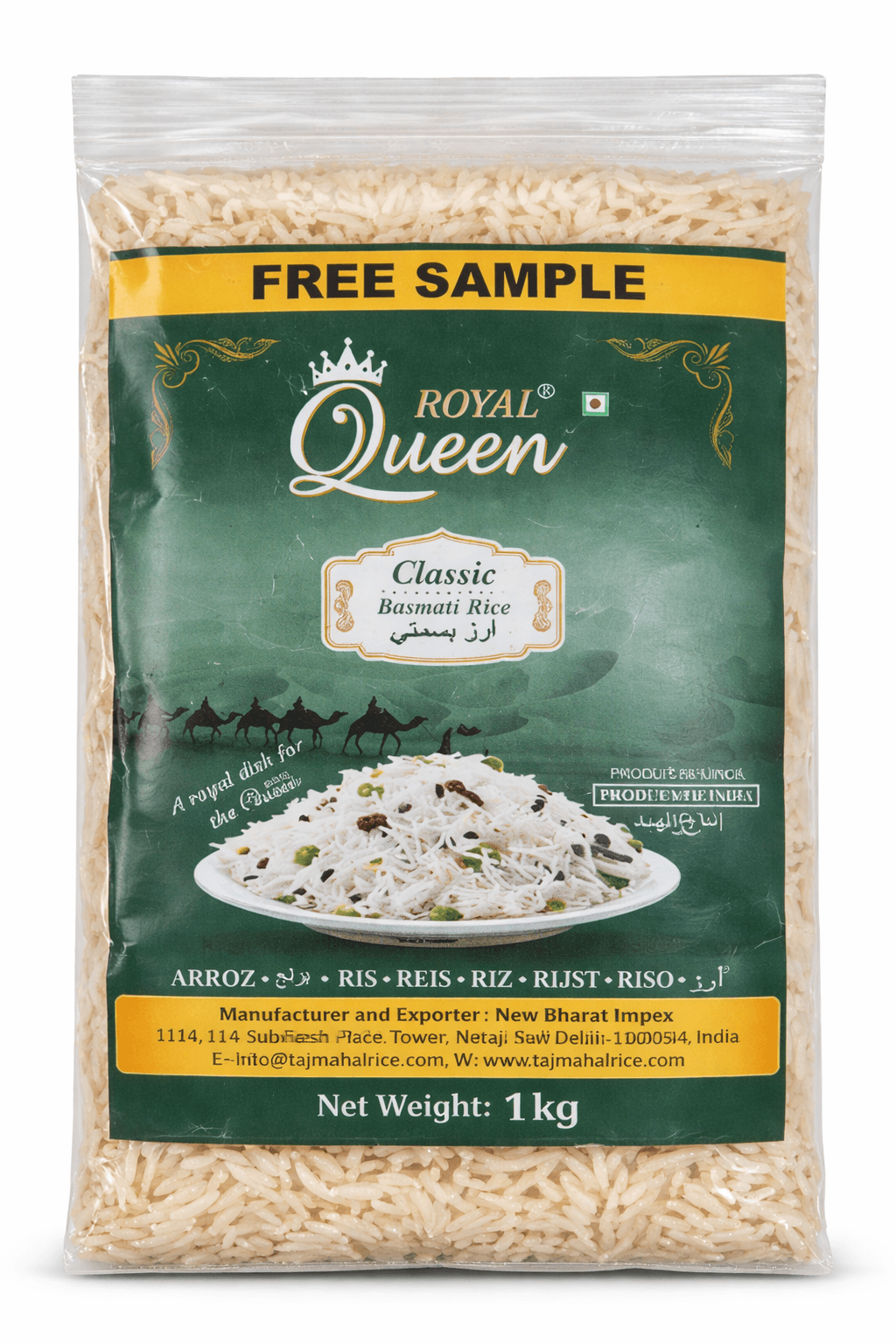
Royal Queen classic basmati rice
€3.39
1 kg
Basmati rice isn't cooked like regular rice: less water, less time, and two steps almost everyone skips. Rinse, soak, and rest 10 minutes.
Basmati is a long-grain rice low in amylopectin, the starch responsible for stickiness. That's what lets it stay fluffy and separate where round-grain rice clumps together. But it's also what makes it fragile: too much water and it falls apart, too little and the center stays hard.
Its second distinctive trait is elongation. A basmati grain nearly doubles in length during cooking without widening. That elongation only happens properly if the grain has been rehydrated before it's heated, which is why soaking matters.
The practical upshot: basmati needs less water and less time than most rice. Applying the reflex "two parts water to one part rice" reliably turns it to mush.
The reference ratio for the absorption method is 1 part rice to 1.5 parts water. Not 2 parts.
• Rice soaked for 30 minutes: 1 part rice to 1.25 parts water
• Rice just rinsed, not soaked: 1 part rice to 1.5 parts water
• Brown basmati rice: 1 part rice to 2 parts water
• Rice cooker: 1 part rice to 1.25 parts water, since the lid limits evaporation
Measure the rice and the water with the same container, never rice by weight and water in a measuring cup. The ratio is by volume.
Rinse the basmati under cold water until it runs clear, usually three to four changes of water. This removes the loose starch that settles on the surface during milling and transport.
Skip this step and that starch gelatinizes in the cooking water and glues the grains together. Rinse it away and the grains separate naturally when fluffed with a fork.
Use a fine-mesh strainer and stir gently with your fingertips rather than rubbing: basmati grains are long and brittle, and a broken grain releases even more starch.
Let the rinsed rice soak for 30 minutes in cold water, then drain it thoroughly. This isn't a folksy extra step: it genuinely changes the result.
Soaking hydrates the grain from the outside in before it hits the heat. The center then cooks at the same rate as the outside, instead of staying firm while the outer layer breaks down.
Added bonus: cooking time drops to 8-10 minutes instead of 12-15, and the grains elongate noticeably more. Beyond an hour of soaking, the grain weakens, so don't go past that mark.
This is the reference method, the one that gives the most flavorful grain because nothing gets poured away with the cooking water.
1. Rinse 200 g of basmati until the water runs clear, then soak for 30 minutes. Drain.
2. Put the rice in a heavy-bottomed saucepan with 250 ml of cold water and 1/2 teaspoon of salt.
3. Bring to a boil uncovered, over high heat.
4. As soon as it boils, cover and turn the heat down to an absolute minimum. Cook for 10 minutes.
5. Don't lift the lid during those 10 minutes. Every peek releases the steam that's doing the work.
6. Turn off the heat and let it rest for 10 minutes, still covered.
7. Fluff with a fork, never a spoon, lifting from the bottom.
For 200 g of dry rice, expect three side-dish portions or two main-course portions.
Off the heat, lid still on, the rice keeps evening itself out. The residual steam finishes hydrating the grains on top while the wetter grains at the bottom firm up.
Skip this rest and you get uneven rice: sticky at the bottom, dry on top. Ten minutes is enough, and the rice stays hot well beyond that.
If your lid doesn't seal well, place a clean kitchen towel between the pan and the lid during the rest to absorb condensation.
Sauté the drained grains for 2 minutes in a little oil or butter, until they turn translucent at the edges, then pour in the boiling water all at once and continue as in the absorption method.
The fat coating seals each grain and guarantees separate, fluffy rice even with average-quality rice. It's the base of both Comorian pilao and Central Asian pilaf.
Use boiling water, not cold: pouring cold water onto hot grains makes them split open.
Drop the rinsed rice into a large pot of boiling salted water, the way you'd cook pasta. Allow 8 minutes for soaked rice, 10 to 11 minutes otherwise, then drain immediately.
Advantage: there's no ratio to get wrong, and the method forgives inconsistent rice quality. Downside: some of the flavor and starch is lost in the cooking water.
Taste a grain at 8 minutes rather than trusting the timer alone. It should be tender with no white core left in the center.
Rinse but don't soak, and cut the water down to 1.25 parts water per 1 part rice. The airtight lid loses far less water to evaporation than a saucepan.
Let the machine switch over to keep-warm on its own, then wait another 10 minutes before opening it. The rest cycle isn't something the machine handles for you.
A teaspoon of oil in the water helps keep grains from sticking to the bottom of the bowl.
Handy for a single portion. In a tall microwave-safe container, combine the rinsed rice, 1.5 parts water and a pinch of salt. Cover loosely, without sealing it airtight.
Microwave for 5 minutes at full power, then 8 minutes at medium power, then let it rest for 5 minutes without opening.
Use a container at least three times taller than the water level: basmati boils over easily.
The cooking water is the only point where aromatics actually penetrate the grain. After that, they just sit on the surface.
• A split green cardamom pod and a clove: the base of Indian-style basmati
• A bay leaf and a cinnamon stick: a gentler profile, well suited to poultry
• A splash of lemon juice: keeps the grains white and well separated
• A pinch of saffron steeped in two tablespoons of hot water, poured in at the end of the rest for marbled rice
• Broth instead of water: salt much more sparingly in that case
Comorian spices (cloves, cinnamon, vanilla) work especially well for this, as long as you add them whole and remove them before serving.
Comorian pilao starts with rice sauteed in a mix of onions, garlic, ginger and whole spices, before the meat broth is added. Basmati is preferred over local rice for how well it holds its shape.
What sets it apart from a classic pilaf is the mix of whole spices (cardamom, cloves, cinnamon, black pepper) and the final gentle, covered cooking that lets the rice soak up the broth.
Use 1.25 parts broth to 1 part rice: the onions release water as they cook.
• Doubling the water out of habit: basmati isn't round-grain rice, 1.5 parts is enough
• Not rinsing: surface starch glues the grains together within the first few minutes
• Stirring during cooking: every stir breaks grains and releases starch
• Lifting the lid to check: the steam you lose doesn't come back
• Cooking over medium heat instead of the lowest setting: the water evaporates before the grain is hydrated
• Serving immediately without resting: guaranteed uneven texture
• Using too wide a pan: the rice layer should be 2 to 3 cm thick, not less
• Side dish: 60 to 70 g of dry rice per person
• Main course, fried rice or biryani: 90 to 110 g per person
• Child: 40 to 50 g
Basmati roughly triples in volume when cooked. 70 g of dry rice yields about 200 g of cooked rice.
Cool the cooked rice quickly, within an hour, by spreading it out on a wide plate. Rice left lukewarm for several hours at room temperature is a breeding ground for Bacillus cereus, whose spores survive cooking.
Store it in the fridge in a sealed container for 24 to 48 hours at most.
To reheat, add a tablespoon of water per 200 g of rice and cover: 2 minutes in the microwave, or in a skillet over low heat. Only reheat it once.
Cooked rice freezes well, in individual portions, for up to a month. Reheat it straight from frozen, with no need to thaw first.
Rice too firm and no water left: add 2 tablespoons of hot water, cover, and cook 5 more minutes over the lowest heat.
Rice too wet but not sticky yet: uncover and leave it over very low heat for 2 to 3 minutes, the excess moisture will evaporate.
Sticky rice: rinse it under hot water in a strainer, drain thoroughly, then toss it in a skillet for 2 minutes with a drizzle of oil. You won't get back the original texture, but the dish becomes presentable again.
Rice burnt at the bottom: immediately transfer the top layer to another container without scraping the bottom. The burnt taste spreads within minutes.