The mkatra foutra is a soft, leavened Comorian bread cooked in a pan, often prepared with coconut milk. For 4 people, allow 500 g of flour, a resting time for the dough of about 1 hour 15 minutes and 8 to 10 minutes of cooking per flatbread. This mkatra foutra Comorian recipe details the quantities, steps and errors to avoid.
If you are looking for a reliable, clear Comorian mkatra foutra recipe suitable for a French kitchen, you have come to the right place. This bread is prepared with few ingredients, but it requires patience and a good heat setting. You will find here a version for 4 people, with precise quantities, resting and cooking times, then the variations that are distinguished in Comorian families. At the end, some reference points for ordering grocery products useful in Moroni, for you or for your loved ones.
Mkatra foutra: reference points to recognise this Comorian bread
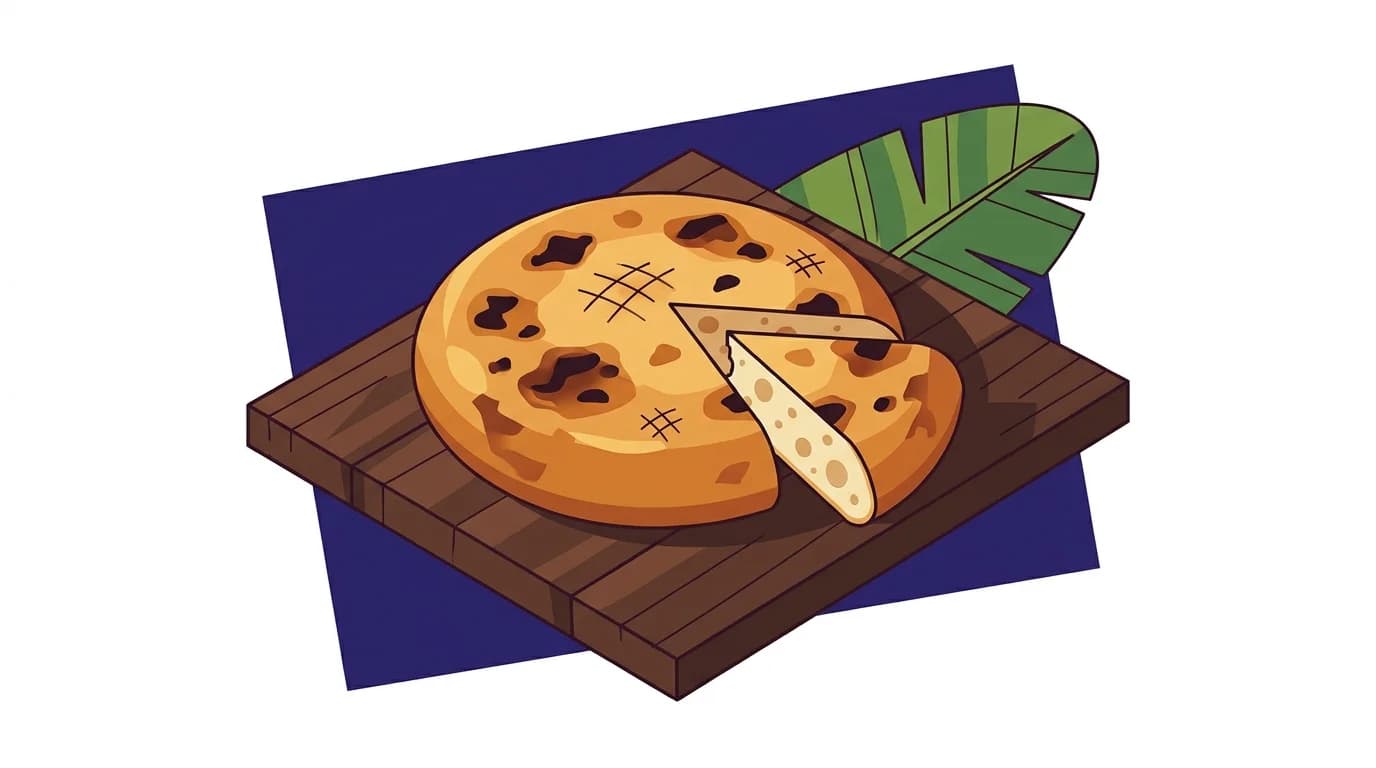
The mkatra foutra is a thick flatbread, cooked in a pan, with a soft and slightly airy crumb. It is prepared with a leavened dough, wheat flour, a little sugar, salt and very often coconut milk, which gives it its subtle fragrance and tenderness. Its crust remains light, with some golden areas.
An everyday bread for moments of sharing
It is served mainly at breakfast or as a snack, with tea, coffee or a hot drink. During Ramadan, it often reappears on the table for breaking the fast, sometimes with a sauce, a savoury topping or a more substantial accompaniment. Uses vary from one family and one island to another: there is not just one way to serve it.
A name that changes according to spelling
The name is written in several ways: mkatra foutra, mkatré wa foutra or even mkatafuta. These spellings refer to similar preparations, because Comorian is transcribed without a unique spelling. The word mkatra designates a family of breads and cakes. Therefore, do not confuse this pan-fried bread with the mkatra siniya, a denser cake, which we present in the section devoted to variations.
Mkatra foutra recipe for 4 people
This quantity makes 8 flatbreads of about 14 cm, i.e. two per person. The dough remains soft and a little sticky: this is normal, and it is what gives a soft crumb.
Ingredients and equipment
| Ingredient | Quantity for 4 | Note |
|---|---|---|
| Wheat flour | 500 g | Sifted if possible |
| Dry baker's yeast | 7 g (1 sachet) | To be purchased separately |
| Sugar | 20 g (1 tablespoon) | Feeds the yeast and browns the crust |
| Fine salt | 1/2 teaspoon | Not to be put in direct contact with the yeast |
| Coconut milk | 300 ml | To be purchased separately, shaken well before opening |
| Lukewarm water | 100 to 120 ml | About 35 °C, to be adjusted |
| Neutral oil | 2 tablespoons in the dough, a drizzle for the pan | Sunflower oil for example |
You will also need a large mixing bowl, a clean tea towel, a thick-bottomed pan (a lid is useful) and a wide spatula.
For the sugar, a Selati refined cane sugar is listed in the catalogue. It is sold in a large format, which is especially suitable for household reserves. For a single batch, one tablespoon is enough.
For the oil, the catalogue offers a Safi sunflower oil, which is suitable for pan-cooking. Any neutral oil will do for this recipe.
Preparation, resting and cooking times
| Step | Indicative duration |
|---|---|
| Preparation and kneading | 20 minutes |
| First rest (proving) | 1 h to 1 h 15 |
| Shaping and second rest | 15 to 20 minutes |
| Cooking per flatbread | 8 to 10 minutes |
| Total with a single pan | about 3 hours |
Taking care of the rising
Yeast likes warmth, not heat. Water that is too hot (above about 45 °C) weakens the yeast and produces flat flatbreads. In winter, place the bowl near a gentle heat source, for example an oven switched off with the light turned on. The dough should have doubled in size and bounce back slightly when you touch it with your finger.
Choosing and treating coconut milk
Canned coconut milk often separates: the thick part rises to the surface. Shake the can before opening, then mix the contents well to distribute the fat. Warm it slightly without boiling it. If it is too cold, it slows down the rising. Choose coconut milk without added sugar, to keep control of the taste.
Mastering pan-cooking
- Medium-low heat: too hot, the outside browns while the middle remains raw.
- Lid: it retains steam and helps the flatbread rise.
- Little fat: a film of oil is enough. The bread is cooked, not fried.
- Cooking test: a cooked flatbread sounds slightly hollow when you tap underneath.
- First flatbread: it serves as a test. Adjust the heat before starting the others.
Correcting small problems
- Dense flatbreads: rising time too short or tired yeast.
- Dry flatbreads: too much flour during shaping or cooking time too long.
- Burnt surface, raw middle: lower the heat and extend cooking under a lid.
- Dough that sticks too much: oil your hands rather than adding flour.
Storing and reheating
Flatbreads can be kept for one day in a tea towel or a closed container. To reheat them, put them in a dry pan for 1 minute on each side, over low heat. You can also freeze them once cooled, separated by parchment paper, then reheat them directly in the pan.
Which mkatra foutra variations should be distinguished?
Comorian families each have their own style. Here are the variations most often encountered, without one being more "authentic" than the other.
| Variation | Main difference | Common usage |
|---|---|---|
| Mkatra foutra with coconut milk | Leavened dough moistened with coconut milk, cooked in a pan | Breakfast, snack |
| Mkatra foutra without eggs | Basic version, without egg in the dough | Simple family recipe |
| Version with egg | An egg added for a richer crumb | According to household habits |
| Mkatra siniya | Fragrant cake, cooked in a dish rather than in a pan | Festive occasions, desserts |
Mkatra foutra without eggs or with egg
Our recipe is egg-free, like the basic version prepared in many households. If you prefer a denser and more golden crumb, add a beaten egg and reduce the water by about 50 ml. You are under no obligation to do so.
Mkatra siniya: another cake, not the same bread
The mkatra siniya has a similar name but follows another logic. It is a fragrant cake, cooked in a dish and not in a pan, with a more compact crumb. It is not prepared with the same dough: so do not replace one with the other in a recipe.
Other adaptations
- Ramadan: smaller flatbreads, served hot with a sauce or a savoury accompaniment.
- Flavouring: some families add a pinch of cardamom, but it is not systematic.
- Size: thinner flatbreads cook faster and are easily cut into portions.
Where to find the ingredients and order for Moroni?
If you live in France, you will find flour, sugar, oil, yeast and coconut milk in most supermarkets and world food shops. If you want your loved ones in Moroni to cook this recipe, you can also send them the products rather than money: you order online, you pay in euros, and your loved ones receive the groceries.
What is in the catalogue
For this recipe, the catalogue references a 25 kg bag of flour. This format corresponds more to a household reserve than to a single batch: 500 g is enough for 4 people. You will also find there the Safi sunflower oil and the Selati refined cane sugar already mentioned above. Coconut milk and baker's yeast are ingredients to be purchased separately: we do not confirm their presence in the catalogue. Always check availability directly on the product pages.
In the same logic of household reserves, we also think of everyday accompaniments, such as the Sultan Crown basmati rice, which is not used for this recipe but completes the household's shopping.
Delivery or collection in Moroni
- Delivery: only in Grande Comore (Moroni and surrounding areas), with a lead time announced of 48 hours after confirmation of payment.
- Collection in store in Moroni: an alternative to delivery for loved ones who prefer to collect the order themselves.
- Payment: by card (Stripe, Apple Pay, Google Pay) or by bank transfer.
- Price: displayed in euros including VAT, with delivery costs indicated separately before payment.
Check the collection conditions and the delivery zone when ordering, as they are specified during the purchase process.
Buy the available ingredients from the catalogue, then add the coconut milk and yeast on your side to prepare your mkatra foutra.
Frequently asked questions
With which dishes to serve mkatra foutra?
Mkatra foutra can accompany a savoury meal, soup or a dish in sauce, and can also be enjoyed at breakfast or as a snack. Serve it plain or with a filling according to your habits and the recipe used. To appreciate its texture, you can present it while still warm, just after cooking.
How to store mkatra foutra after cooking?
Let the bread cool, then place it in an airtight container or wrap it in a clean cloth so that it does not dry out too quickly. Keep it at room temperature if you intend to eat it quickly. For longer storage, you can freeze it well-wrapped, then reheat it once defrosted.
Can you prepare the mkatra foutra dough in advance?
Yes, advance preparation is possible, but the resting time depends on the recipe and the ambient temperature. Cover the dough and follow the instructions provided for fermentation. If you keep it in the refrigerator, check its texture before cooking and let it return to an easy-to-spread consistency, without adding liquid immediately.
Can you modify the ingredients of a mkatra foutra recipe?
A substitution can change the texture, taste or hold of the bread. To preserve the result, avoid replacing several ingredients at once and proceed with small adaptations. Take into account the consistency of the dough, because flours and liquids do not all absorb in the same way. The chosen recipe remains the best reference.
How to reheat mkatra foutra without drying it out?
Reheat the mkatra foutra briefly in a pan over low heat, turning it if necessary. Moderate heat helps to regain a soft texture without drying out the surface too much. You can cover the pan for a few moments to retain moisture. Avoid prolonged cooking, which risks making the bread hard.